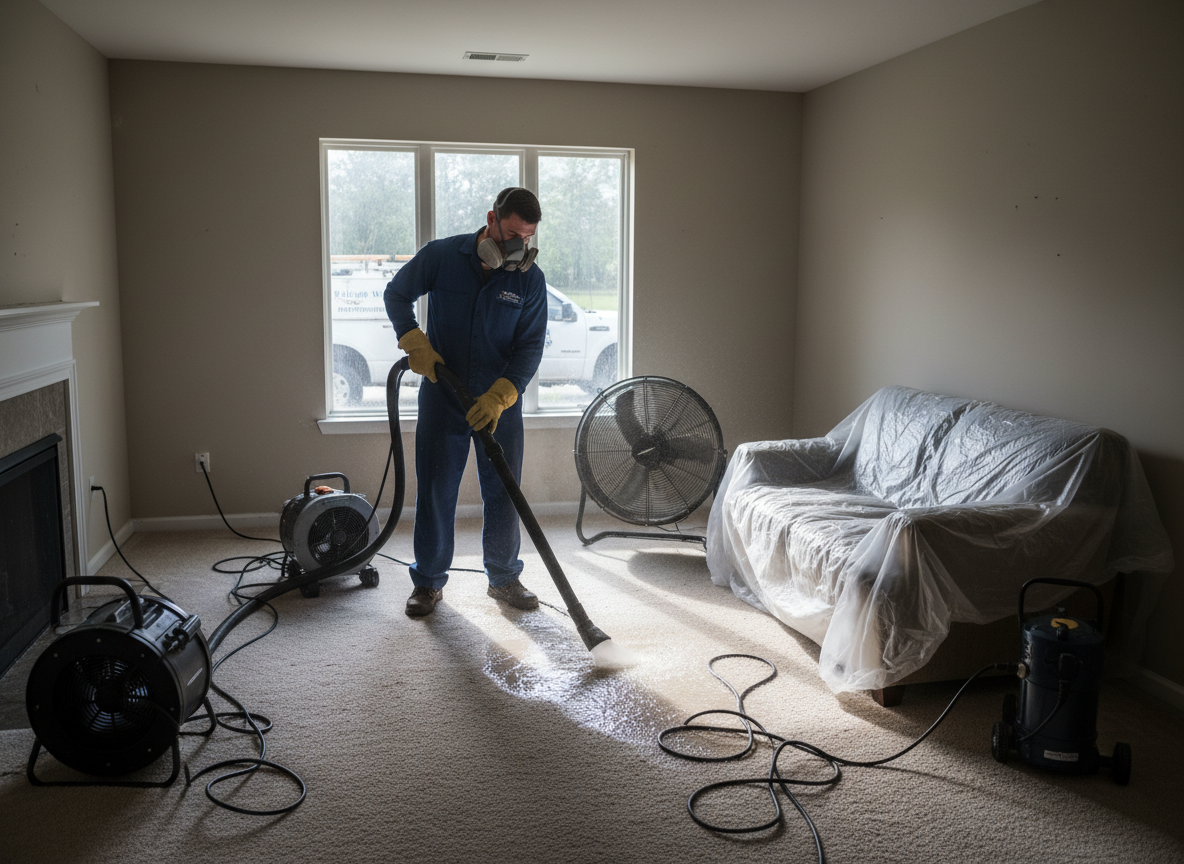
Raleigh's humid subtropical climate brings hot summers that push indoor moisture levels high enough to turn minor leaks into mold colonies within 48 hours. Older homes in Oakwood, Boylan Heights and Hayes Barton often have plaster over lath or balloon-frame construction that hides water behind walls and under floors, requiring moisture meters and infrared scans rather than visual checks alone. Clay-heavy soils around Falls of Neuse and Five Points slow drainage, so even moderate rain can send water into crawl spaces and basements of homes built before modern grading standards.
Wake County properties near the North Carolina State Capitol or Cameron Village frequently sit on lots where storm drains back up during heavy summer thunderstorms. When water reaches subflooring in these areas, technicians must pull baseboards and drill weep holes to prevent hidden rot in the joists. Nearby cities like Cary and Durham share similar red-clay terrain, but Raleigh's denser historic districts add extra steps for working around narrow lots and shared walls without disturbing neighboring structures.
After extraction, drying equipment must run longer here than in drier climates because ambient humidity stays elevated into fall. Technicians monitor dew points daily and adjust dehumidifiers to keep wood moisture content below 12 percent before any reconstruction begins. This prevents callbacks when summer humidity returns and residual moisture reappears behind new drywall.
Technician insight
In Raleigh, the thing that catches most people out with Water Damage Restoration is how fast hidden moisture travels through the plaster and lathe in pre-1950 homes around Oakwood and Mordecai when our summer humidity stays above 70 percent.
North Hills Basement Leak
Heavy rain overwhelmed a French drain on a 1960s split-level near North Hills. Water wicked up behind finished walls and into the oak subfloor. Crew extracted water, removed baseboards, and ran drying equipment for six days until readings dropped below 12 percent. New drywall and flooring were installed without further mold issues.
Water Damage Restoration Services We Offer
✓Emergency Water Extraction
Rapid removal of standing water from basements and first floors using truck-mounted pumps before mold growth accelerates in Raleigh's humidity.
✓Structural Drying and Dehumidification
Industrial air movers and low-grain dehumidifiers placed to pull moisture from plaster, hardwood and subfloors common in North Hills and Mordecai homes.
✓Mold Prevention After Water Damage
Antimicrobial treatment and HEPA air scrubbing applied once drying is complete to stop spores from spreading in humid Wake County conditions.
✓Drywall and Insulation Removal
Selective demo of affected walls in older Oakwood and Boylan Heights properties to eliminate saturated materials that cannot be salvaged.
✓Hardwood Floor Restoration
Sanding and refinishing of original heart-pine floors after water events, with care taken around historic homes near Pullen Park.
✓Crawl Space Water Cleanup
Pumping and vapor-barrier installation in homes on clay soils where poor drainage allows repeated moisture intrusion.
Water Damage Restoration Cost in Raleigh, NC
| Service | Typical Range | What Affects It |
|---|---|---|
| Initial Assessment | Free | Waived when restoration work proceeds |
| Water Extraction | $800–$2,200 | Varies by volume and access in older homes |
| Full Structural Drying | $1,200–$3,500 | Depends on number of rooms and humidity levels |
| Drywall Removal And Replacement | $1,500–$4,000 | Higher in historic plaster homes |
Ranges are typical for Raleigh, NC and confirmed with an exact written quote before any work starts.
How it works
- 1
On-Site Assessment
Technician inspects all affected rooms with moisture meters and documents hidden water in walls and under floors.
- 2
Water Removal
Pumps and extractors clear standing water while protecting salvageable contents and flooring.
- 3
Drying Phase
Equipment runs continuously with daily moisture readings until materials reach safe levels for Raleigh humidity.
- 4
Rebuild And Final Check
New materials installed and final walkthrough confirms no residual moisture remains.
Pricing
Upfront written quotes after inspection; final cost depends on square footage, depth of water, and materials affected.